Current version: 1.0.7
Core software
Velora API Server (Core)
Central server core for Velora
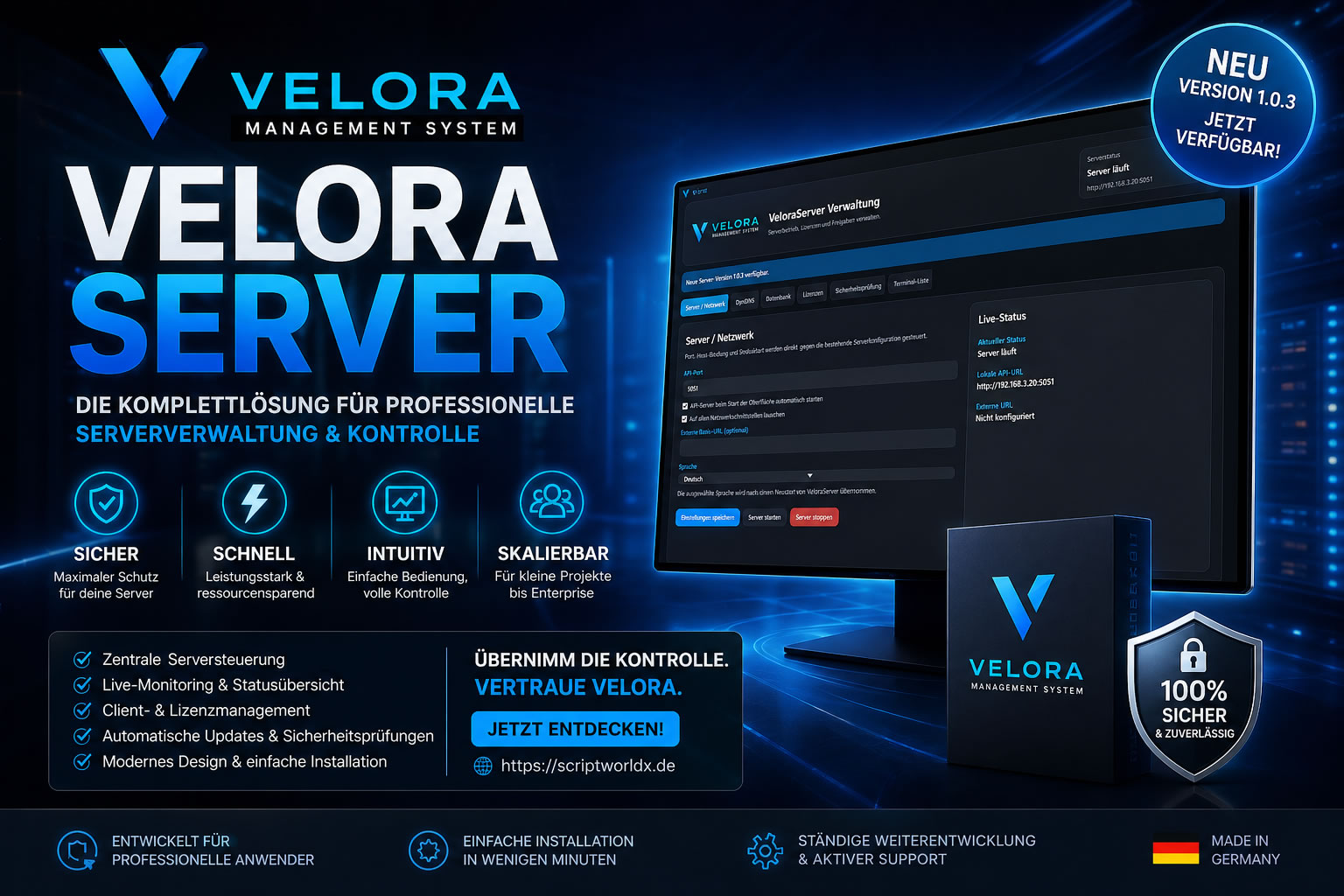
Velora Server provides the central foundation for connecting, managing and using Velora across a network.
Velora Server is the central server component for Velora and provides the technical foundation for using the software in a networked environment. The server supports connections from multiple Velora clients and provides central services for shared use.
The solution is suitable for businesses, teams and locations where Velora should not only run on a single workstation, but be used in a structured network setup. Velora Server helps provide data, connections and system functions centrally while keeping the Velora environment clearly organized.
Velora Server is designed for users who need a stable basis for multi-user operation or centralized management of their Velora installation.
Note: Suitable Velora client applications are required for productive use.
The solution is suitable for businesses, teams and locations where Velora should not only run on a single workstation, but be used in a structured network setup. Velora Server helps provide data, connections and system functions centrally while keeping the Velora environment clearly organized.
Velora Server is designed for users who need a stable basis for multi-user operation or centralized management of their Velora installation.
Note: Suitable Velora client applications are required for productive use.
Choose a license edition
System requirements
Operating System:
Windows 10/11 or Windows Server, 64-bit
Processor:
At least a dual-core CPU, quad-core or better recommended
Memory:
At least 8 GB RAM, 16 GB RAM or more recommended
Storage:
At least 1 GB of free disk space for the application, configuration, and logs.
Additional storage required depending on database size, documents, POS data, and transaction data.
Database:
MySQL or MariaDB is required for server operation.
Network:
A TCP/IP network is required if clients or POS systems need to access the server. The integrated Velora API server uses port 5050 by default, but this can be customized. The port must be allowed in the Windows Firewall if external clients need to connect.
Permissions:
Administrator privileges are required for installation and setup.
Write access to the local data directory is required.
Internet:
An internet connection is required for license verification, activation, and updates.
Windows 10/11 or Windows Server, 64-bit
Processor:
At least a dual-core CPU, quad-core or better recommended
Memory:
At least 8 GB RAM, 16 GB RAM or more recommended
Storage:
At least 1 GB of free disk space for the application, configuration, and logs.
Additional storage required depending on database size, documents, POS data, and transaction data.
Database:
MySQL or MariaDB is required for server operation.
Network:
A TCP/IP network is required if clients or POS systems need to access the server. The integrated Velora API server uses port 5050 by default, but this can be customized. The port must be allowed in the Windows Firewall if external clients need to connect.
Permissions:
Administrator privileges are required for installation and setup.
Write access to the local data directory is required.
Internet:
An internet connection is required for license verification, activation, and updates.